
Screen guide · Web app
Add Fee Rule
Create an automatic fee rule: a discount that applies by student category (such as Staff Child or RTE) or by sibling position (second and third child), with a discount per fee head.
यह पेज अंग्रेज़ी में है। कुछ समझ न आए तो ।
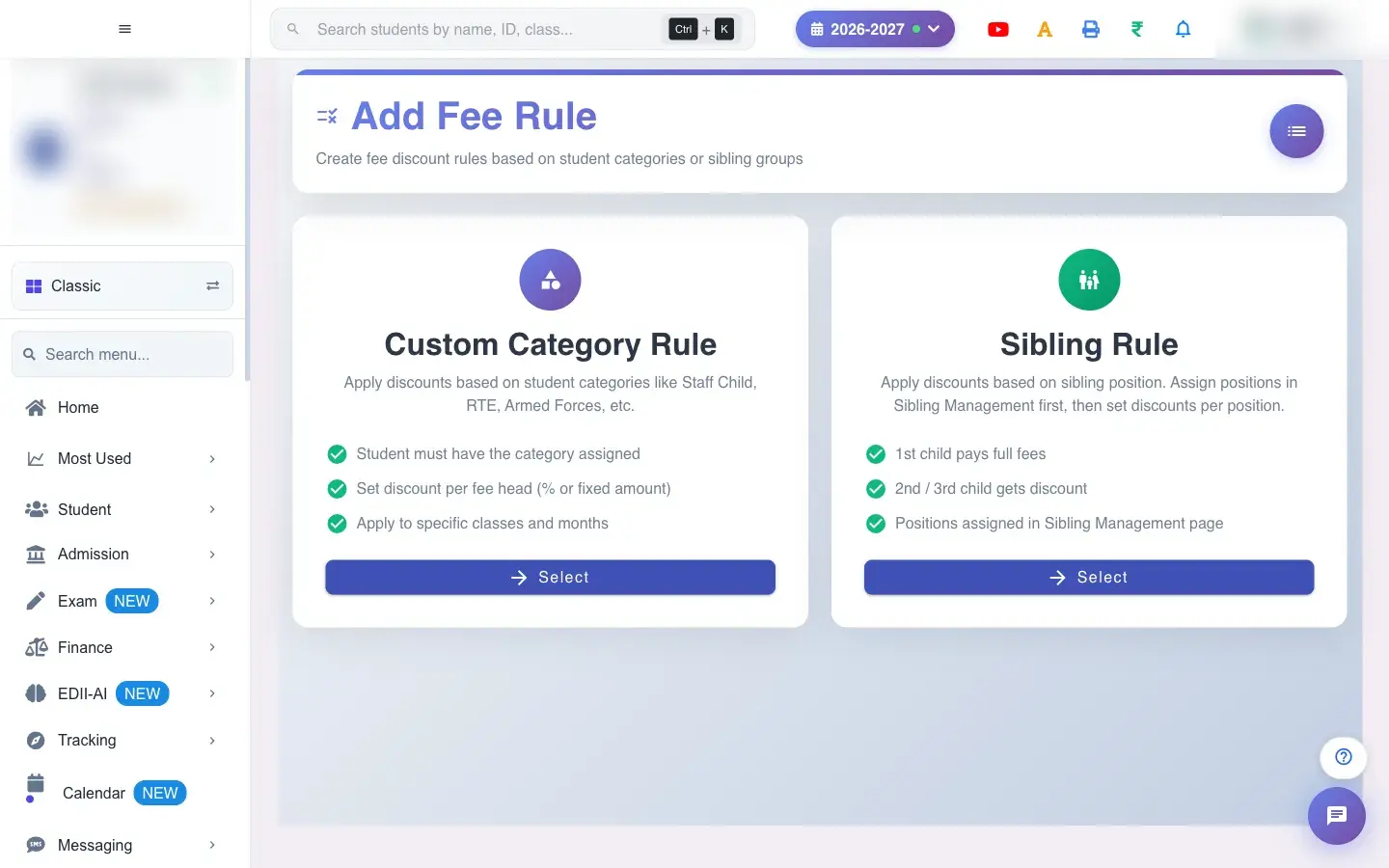
Add Fee Rule (Finance › Add Fee Rule) sets discounts that apply on their own. Instead of adding students one by one, you define a rule and every student who matches it gets the discount.
There are two kinds. Custom Category Rule applies a discount to students who have a category assigned (Staff Child, RTE, Armed Forces and so on). Sibling Rule applies a discount by sibling position: the first child pays full fees and the second and third children get a discount. Sibling positions are assigned on the Sibling Management page first.
Who uses it and when
Section titled “Who uses it and when”The accounts head sets rules once per session, after the school decides its concession policy.
Before you start
Section titled “Before you start”- For a category rule, students must already have the category set on their record.
- For a sibling rule, assign sibling positions in Sibling Management first.
- Fee heads must exist so you can set a discount for each.
Where to find it
Section titled “Where to find it”- Menu: Finance › Add Fee Rule
- Address:
/add/add-fee-rule-discount - If it is missing from your menu, your role does not include it. Ask your school admin.
 Open a bigger pictureतस्वीर बड़ी करें
Step by step
Section titled “Step by step”1. Choose the rule type
Section titled “1. Choose the rule type”Select Custom Category Rule (students with the category get the discount) or Sibling Rule (by position). Select the card’s Select button.
2. Name the rule and set its priority
Section titled “2. Name the rule and set its priority”Enter a Rule Name and a Priority. When a student matches more than one rule, the one with the better priority is used. For a category rule with several categories you can tick Combo rule: student must have ALL selected categories. For a sibling rule you choose which child positions it is for; the first child pays full fees.
3. Choose categories (category rule)
Section titled “3. Choose categories (category rule)”Pick the categories the rule is linked to. At least one is required.
4. Choose classes, sections and months
Section titled “4. Choose classes, sections and months”Select Class (or Select All), Select Section and Select Months say where and when the rule applies.
5. Set the fee overrides
Section titled “5. Set the fee overrides”Fee Overrides is where you define the discount per fee head, as a percentage or a fixed rupee amount. Each fee head shows its base amount and the amount after the discount (for example Rs. 1000 → Rs. 900). Fees you leave out stay at the base amount. Add at least one override or you see Please add at least one fee override.
6. Save the rule
Section titled “6. Save the rule”Save the rule. The message Fee Rule: <name> … confirms it.
Fields and filters
Section titled “Fields and filters”| Field | What it is | Notes |
|---|---|---|
| Rule Name | Label for the rule. | Required. |
| Priority | Which rule wins when several match. | Required. |
| Categories | Student categories the rule applies to. | Required for category rules. |
| Class / Section / Months | Where and when it applies. | Class and months required. |
| Fee Overrides | Discount per fee head (% or amount). | At least one. |
Buttons
Section titled “Buttons”| Button | What it does | What happens next |
|---|---|---|
| Select (rule type) | Chooses category or sibling rule. | Opens that form. |
| Save rule | Creates the rule. | Fee Rule: <name> …. |
After you save
Section titled “After you save”- The rule is stored. Students who match it are charged the discounted amounts for the chosen months, automatically.
- The rule appears in View/Edit Rules.
Good to know
Section titled “Good to know”- Name, priority, class and months are required.
- A category rule needs at least one category.
- At least one fee override is required.
Messages you may see
Section titled “Messages you may see”| Message | What it means | What to do |
|---|---|---|
| Please add at least one fee override | No discount was defined. | Add a fee head override. |
| Fee Rule: <name> … | The rule was created. | Check View/Edit Rules. |
| Bad/Slow Internet Connection | A request failed. | Try again. |
- Use a combo rule when a student must hold two categories to qualify.
- Give broad rules a lower priority than specific ones.
Stuck? Try this
Section titled “Stuck? Try this”| Problem | Likely cause | What to do |
|---|---|---|
| A student did not get the discount | They lack the category or sibling position, or a better rule applied. | Check their category or sibling position and the rule priority. |
Did this page help?क्या इस पेज से मदद मिली?
Thanks! Glad it helped.धन्यवाद! अच्छा लगा कि काम बन गया।
Sorry about that. Ask in your own words, or write to us.माफ़ कीजिए। अपने शब्दों में पूछें, या हमें लिखें।